A Look at Legends - Solemn Simulacrum
28 Mar 2026Today, I want to take a look at Solemn Simulacrum, a card in Magic the Gathering with a great story, and one that has stood the test of time. Why does it stir our hearts? Why does it work as a card?
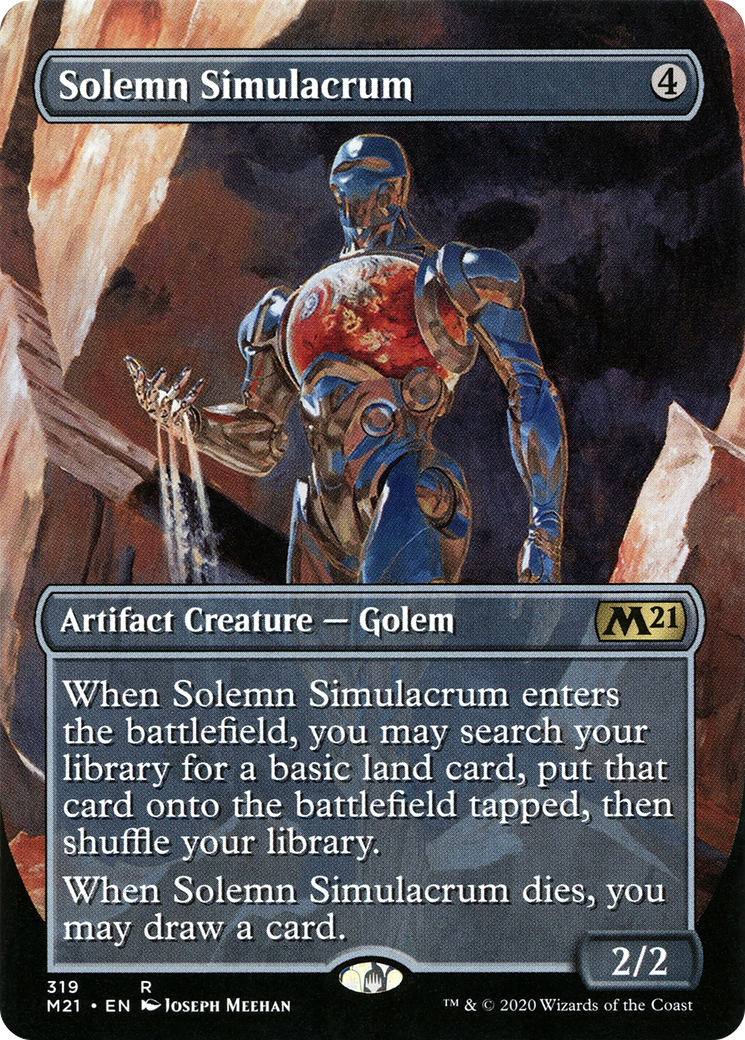
Solemn Simulacrum is a 4 mana artifact creature with a power/toughness of 2/2. When you play Solemn Simulacrum, you can look through your deck for a basic land and play it tapped onto the battlefield. When Solemn Simulacrum dies, you can draw a card.
For four mana of any color, you can get more mana of a specific color, a body on the field, and a card draw when it dies. Solemn Simulacrum is flexible, adds value, and protects its player, leading to it being considered for any deck trying to gain value and power through to the mid or end game. Plus, it looks cool.
Backstory
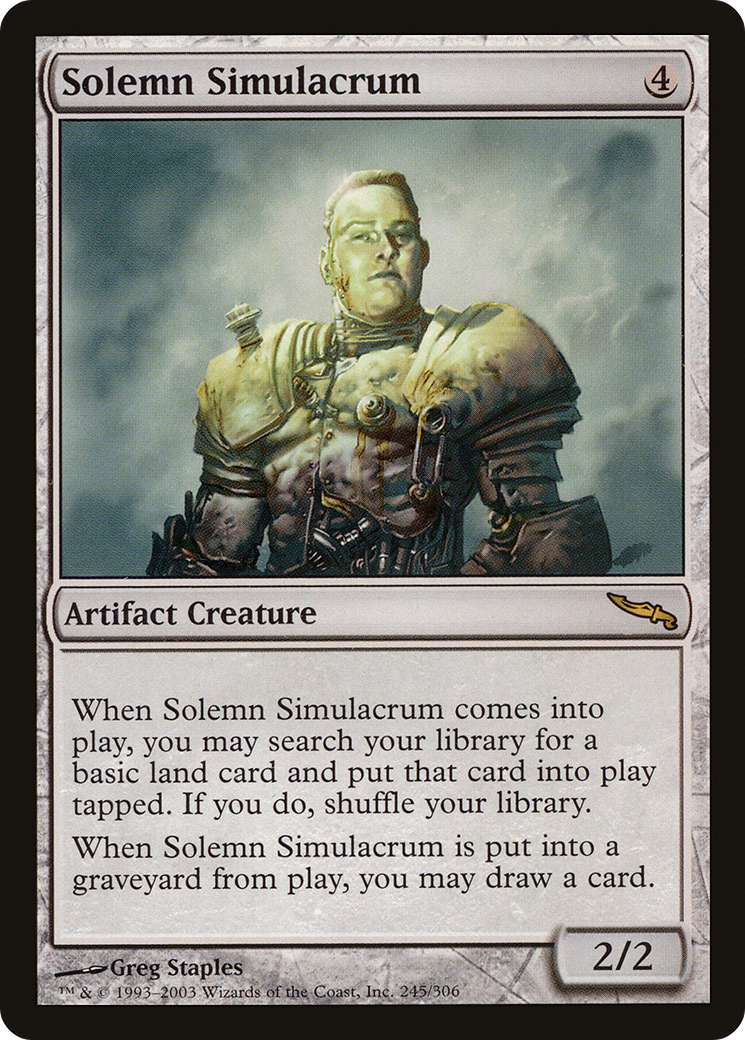
Solemn Simulacrum’s origin is just as interesting as the card itself. Gavin Verhey, principal game designer of Magic the Gathering, tells the story of how Solemn Simulacrum came to be in his Good Morning Magic video.
The card design is submitted by Jens Thorén, a magic player who won a Magic event called The Magic Invitational back in 2002.
The winner got their own card design made as a real Magic the Gathering card.
Jens submitted their card design as follows.
Forestfolk
2{G}{B}
Creature - Elf Wizard
2/2
When Forestfolk comes into play, you may search your library for a basic land card and put that card into play tapped. Then shuffle your library.
When Forestfolk leaves play, draw a card.
The submitted design is remarkably close to the version that was printed. The only changes were making the mana generic, instead of requiring one green and one blue mana, making the creature an artifact, and changing the leaves play trigger to a trigger that happens on death.
Ever since then, Solemn Simulacrum has been a welcome addition to standard decks, limited pools, and commander brews.
Easy to Add Value Piece
When looking at cards with abilities that happen when the card is played, I like to think of them as a creature and a spell stapled together. Cards with abilities that happen when they die are similar, except the ability takes longer to happen, and the other player can take steps to prevent that creature from dying, and that ability from happening. When you have both abilities on a creature, you staple two spells to it.
From that perspective, we can think of Solemn Simulacrum as a Bear Cub with a Shared Roots and Obsessive Search stapled onto it – all with no color restriction.
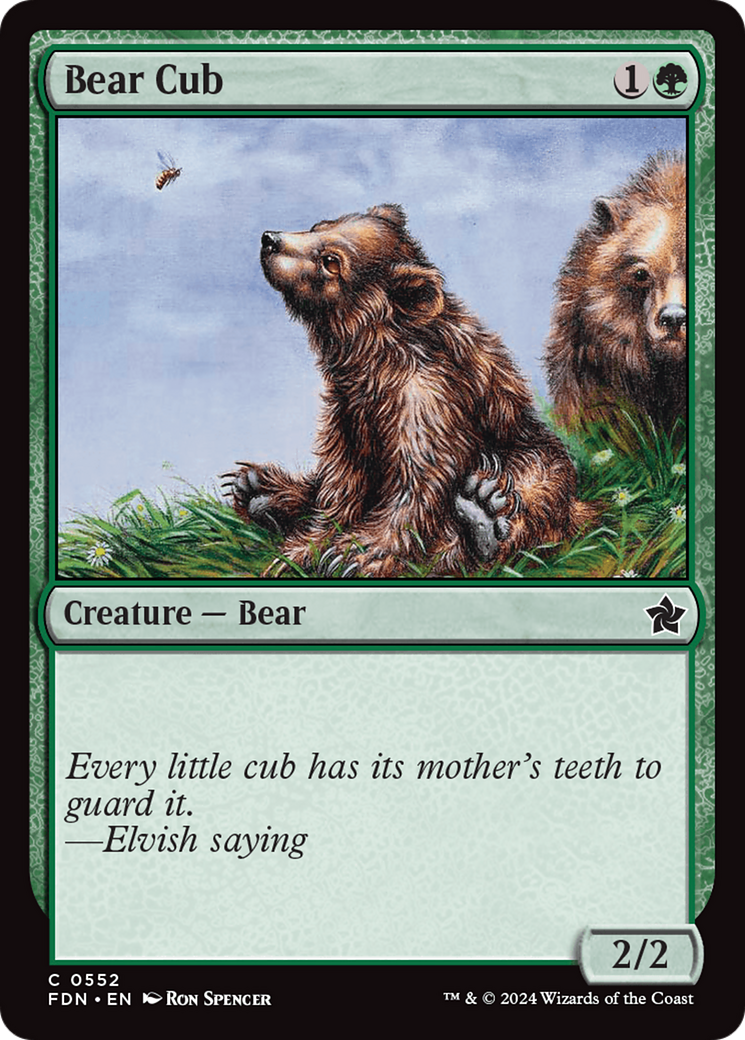
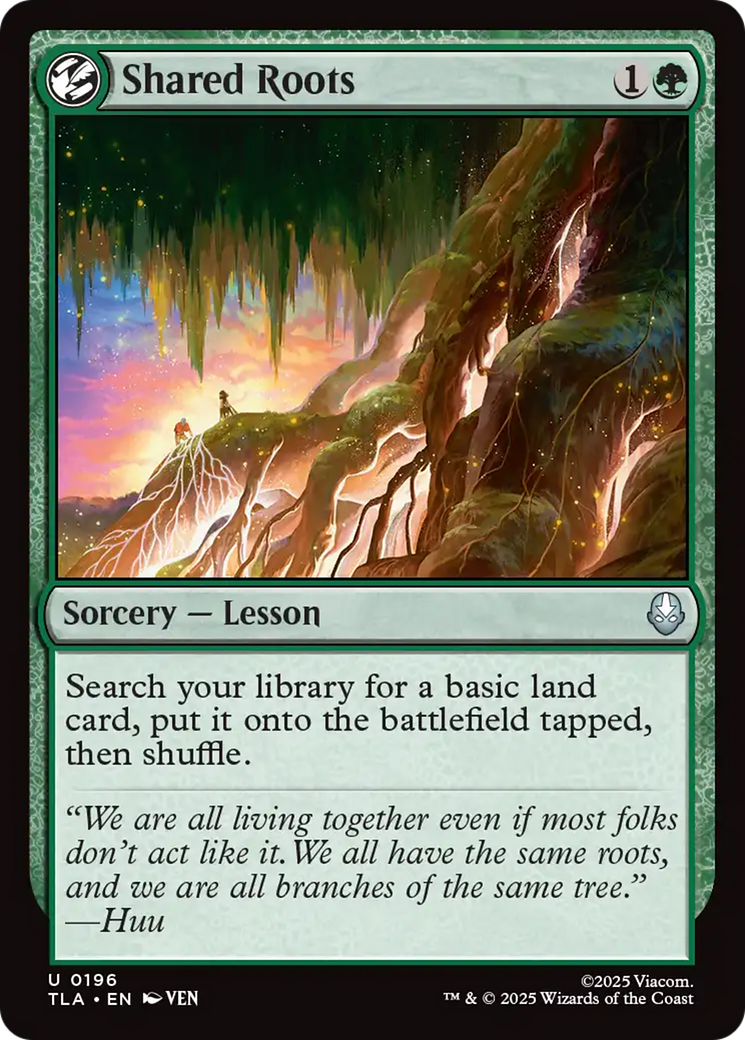
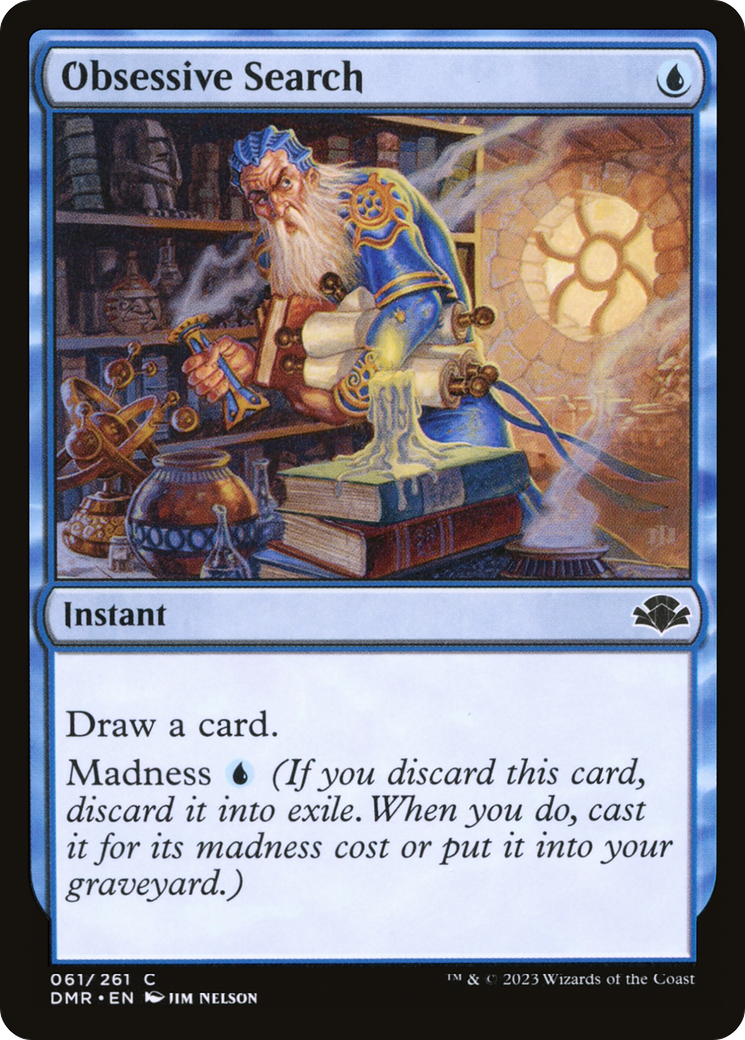
This is one of the reasons for Solemn Simulacrum’s popularity. You get three cards in one that can go into any deck.
Asymmetrical Enters and Death Abilities
An interesting detail of Solemn Simulacrum is that its enter ability and death ability do different things. We can contrast that with creatures that have the same ability that is triggered on entering the battlefield and dying.
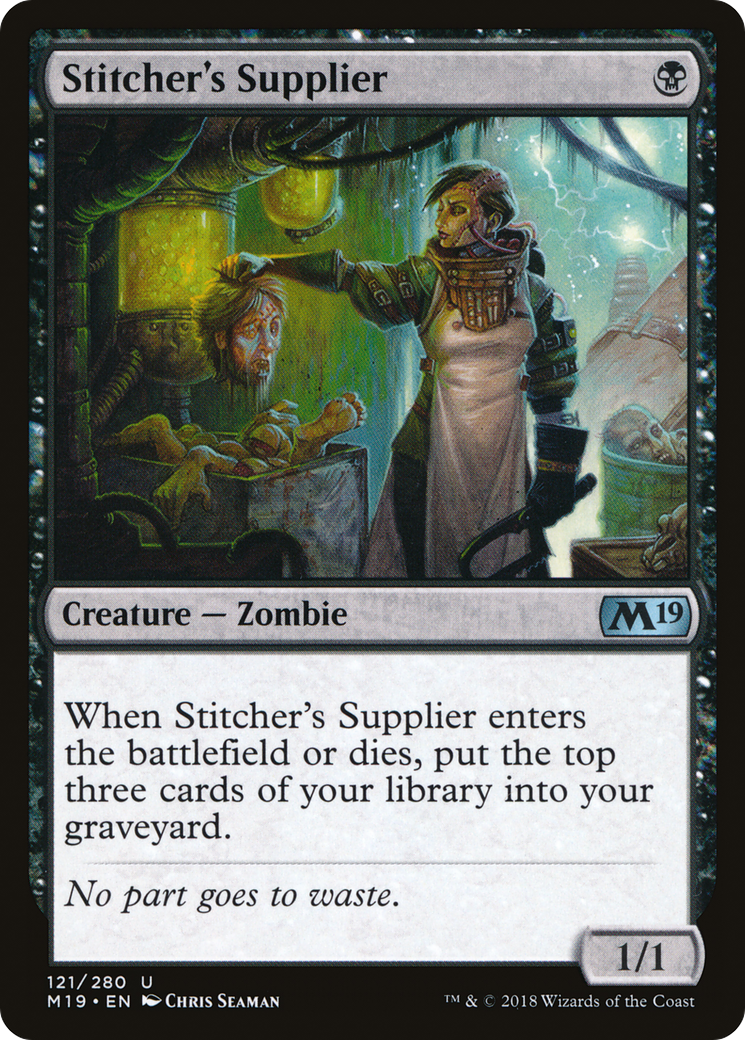
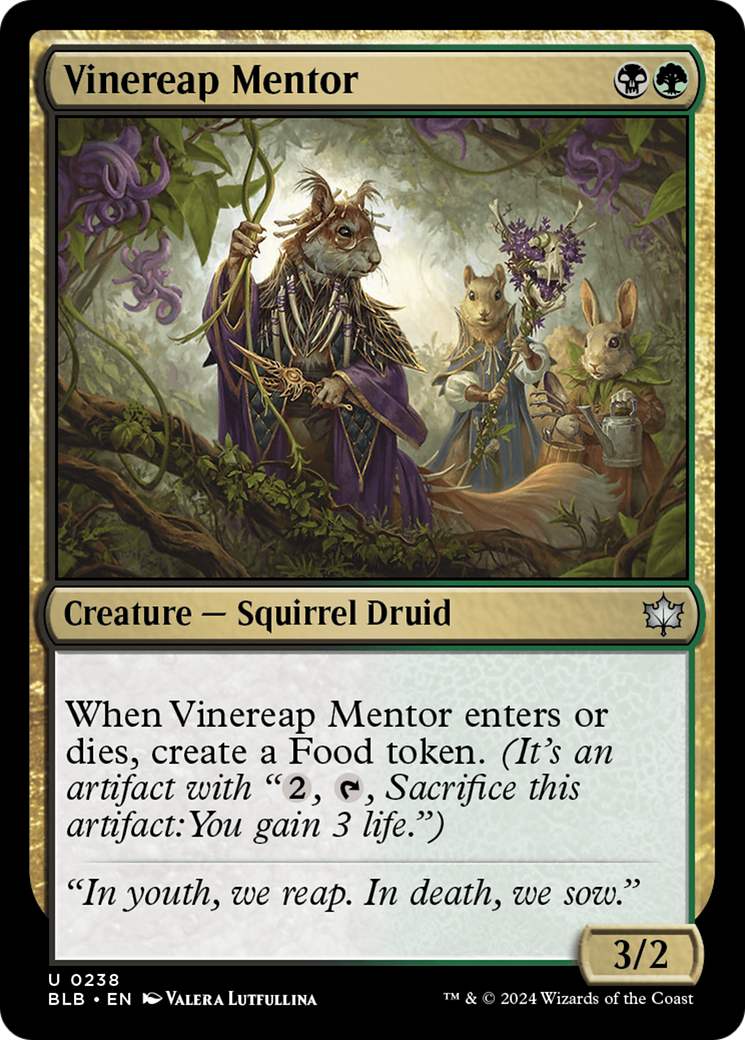
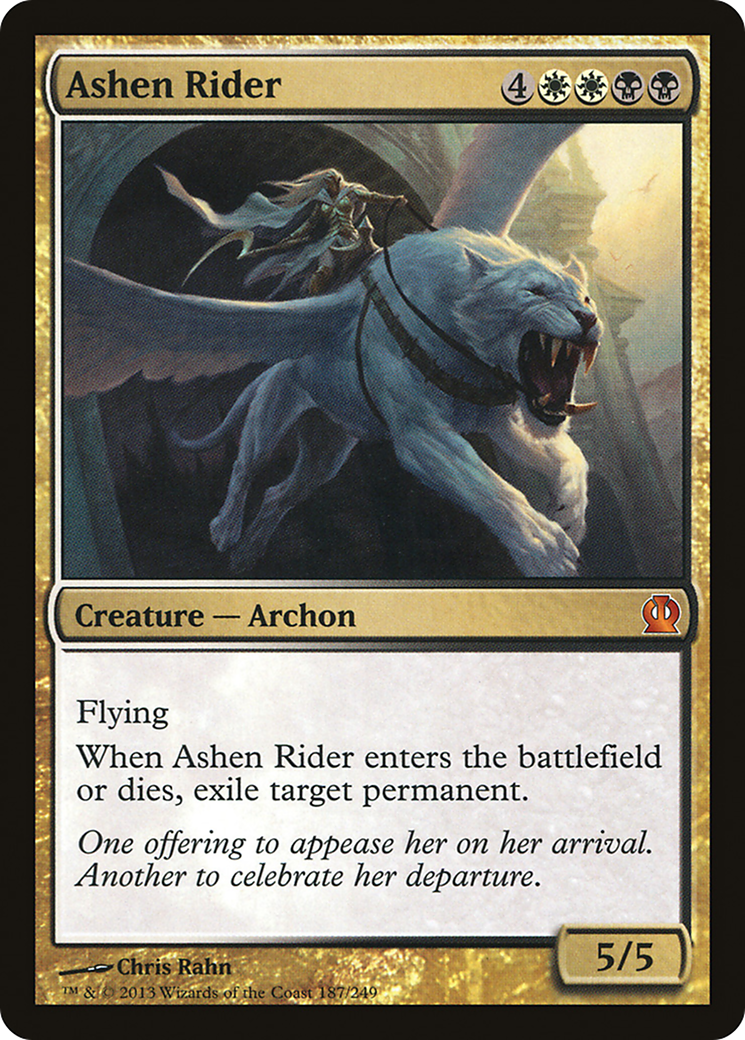
These cards with two ways of triggering their effects are easier to understand and have shorter text boxes. For cards that generate resources or help with payoffs in your deck, two triggers can be great.
However, these cards can be somewhat simple and flat compared to cards with two abilities. Not that simplicity isn’t valued – I enjoy simple design, and I think that complexity is a cost. If you add complexity to your design, you should be using it to make something interesting or fun.
With Solemn Simulacrum and asymmetrical enter and death abilities, we add a little complexity, and get a lot of design space back in return.
Asymmetrical entering abilities and death abilities help to tell a story about a card’s journey. You can tell a before and after story, much like transformation cards like Ecstatic Awakener. With entering triggers and death triggers, you can achieve this same setup and payoff with only one side of a card.
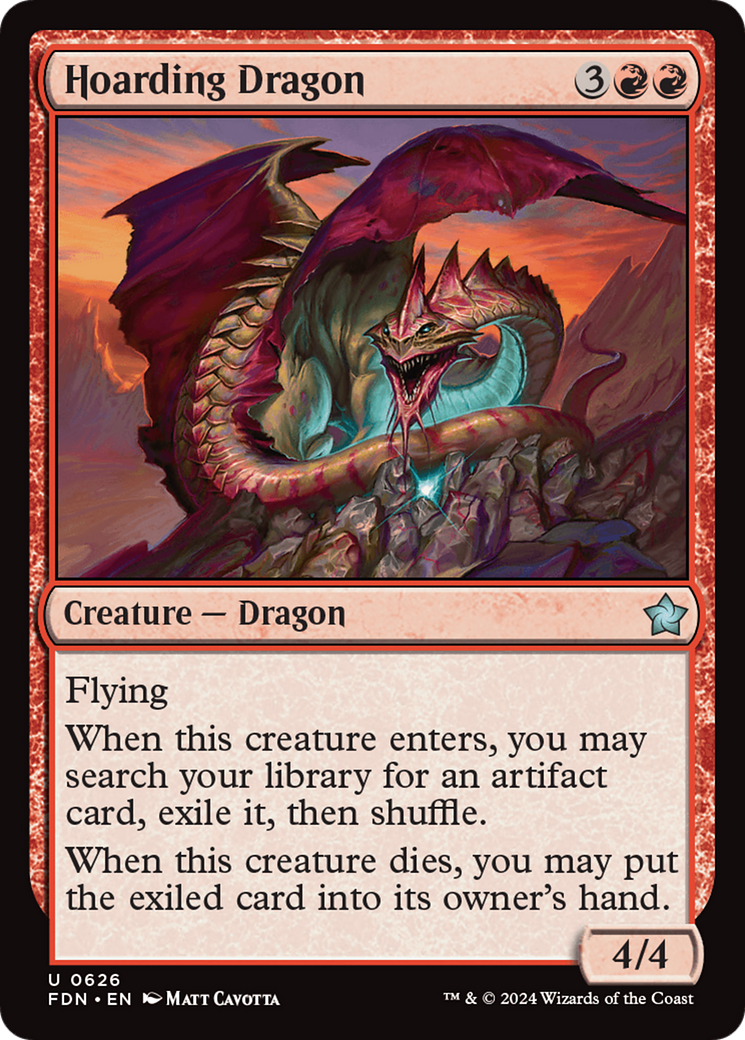
Hoarding Dragon above shows how the asymmetrical entering and death triggers can tell a story. Here we have a dragon who searches and snatches away a valuable artifact, as dragons often do. When the dragon is slain, the artifact is returned. You could even have a Hoarding Dragon snatch a Solemn Simulacrum!
Does Solemn Simulacrum’s abilities help tell a story? Does Solemn Simulacrum enter the battlefield looking for something, and brings in a land to represent its journey? Does it know that its owner will benefit from its death?
Solemn Simulacrum received its first flavor text 21 years after its initial printing. It reads
It has outlasted its creator, their kingdom, and even the castle walls, but still it stands watch.
Perhaps its sojourn is a search for meaning after being abandoned for so long, and its death brings sweet release.
Conclusion
When Jens Thorén submitted their design for Forestfolk, they probably had no idea that the end product would become as popular as Solemn Simulacrum. A flexible card that adds mana ramping and card draw, has a great origin story, and evokes a tragic tale has captured the hearts and minds of Magic players over decades.