Celebrating the Commons - Ecstatic Awakener
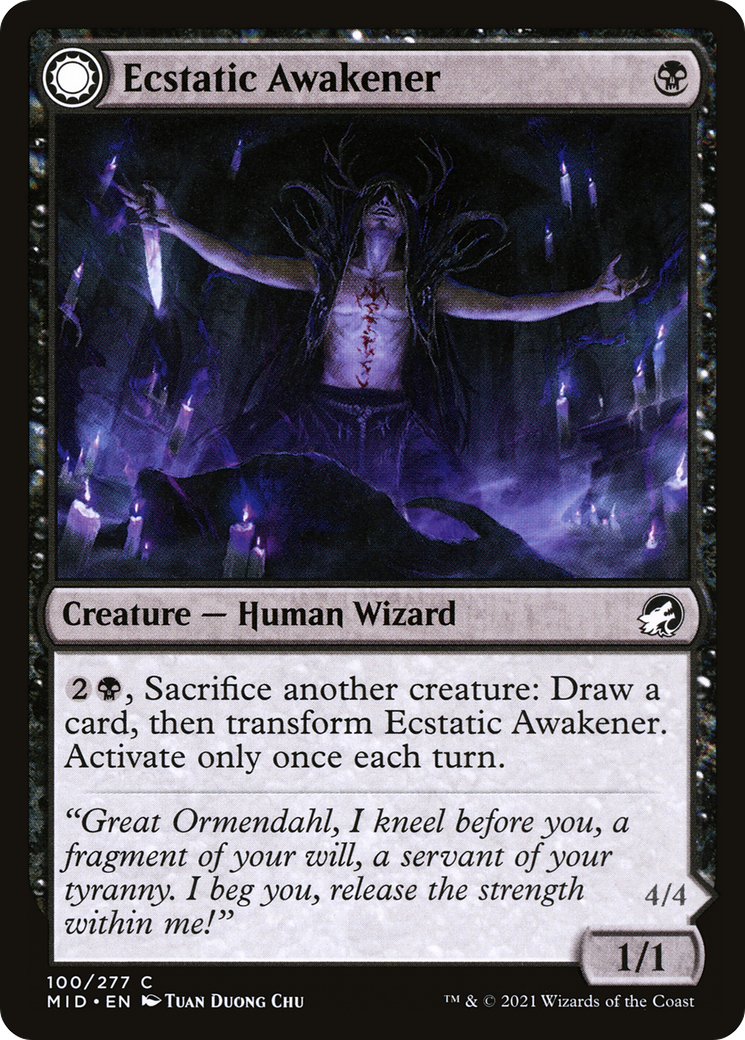
28 Feb 2026Let’s take a look at one of my favorite common cards in Magic the Gathering – Ecstatic Awakener // Awoken Demon.
Description
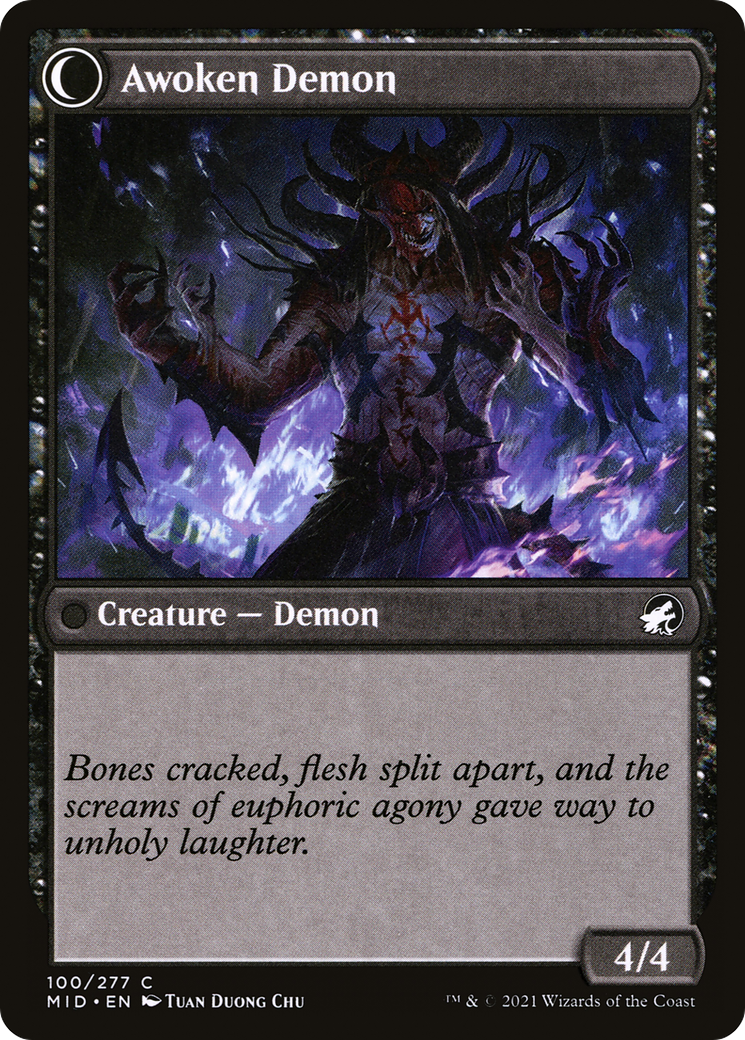
Before we talk about the card proper, I want to make a note that the card Ecstatic Awakener // Awoken Demon is a double faced card. One side shows Ecstatic Awakener, and the other side shows Awoken Demon. You can only play this card from your hand as Ecstatic Awakener – there’s no way to cast it as Awoken Demon from your hand.
Ecstatic Awakener is a black common creature that costs one black mana, has 1 power and 1 toughness, and is a Human.
A Human creature that is a 1/1 is a representation of what the average person would be if they were cast as a creature spell in a game of Magic the Gathering. If you search for 1/1 Humans throughout all of the cards in Magic, you’ll find more than 500 cards.
Note: A squirrel is also represented as a 1/1 creature as well, meaning that if you were a creature in Magic, you would die to a squirrel. Make of that what you will.
The text box for Ecstatic Awakener has an activated ability that has a cost of paying three mana (one black mana and two mana of any kind), and sacrificing another one of your creatures. Your reward for this cost is that you get to draw a card and transform Ecstatic Awakener by flipping it over to its other side, Awoken Demon.
Awoken Demon is a black common creature that has 4 power, 4 toughness, and is a Demon.
Mechanically, the most (and possibly only) interesting thing about this card is its ability.
{2}{B}, Sacrifice another creature: Draw a card, then transform this creature. Activate only once each turn.
Sacrificing
Sacrificing can a large cost to activate an ability or cast a spell. Mechanically, you are giving up a creature that you have drawn from your deck and played onto the battlefield in exchange for something else.
Sacrificing also has a psychological component – you’re giving up something in exchange for something else.
If you only have strong creatures on your side of the field, or creatures that you’re particularly fond of, the cost of sacrificing would prevent you from activating this ability.
On the other hand, if you have many cheap creatures, or creatures that make for good sacrifice fodder, or you find some pleasure in the act of removing creatures (no matter who controls them), then the cost of sacrificing goes down.
If you want to build a whole deck around easily paying sacrifice costs, you could add Novice Occultist to your deck.
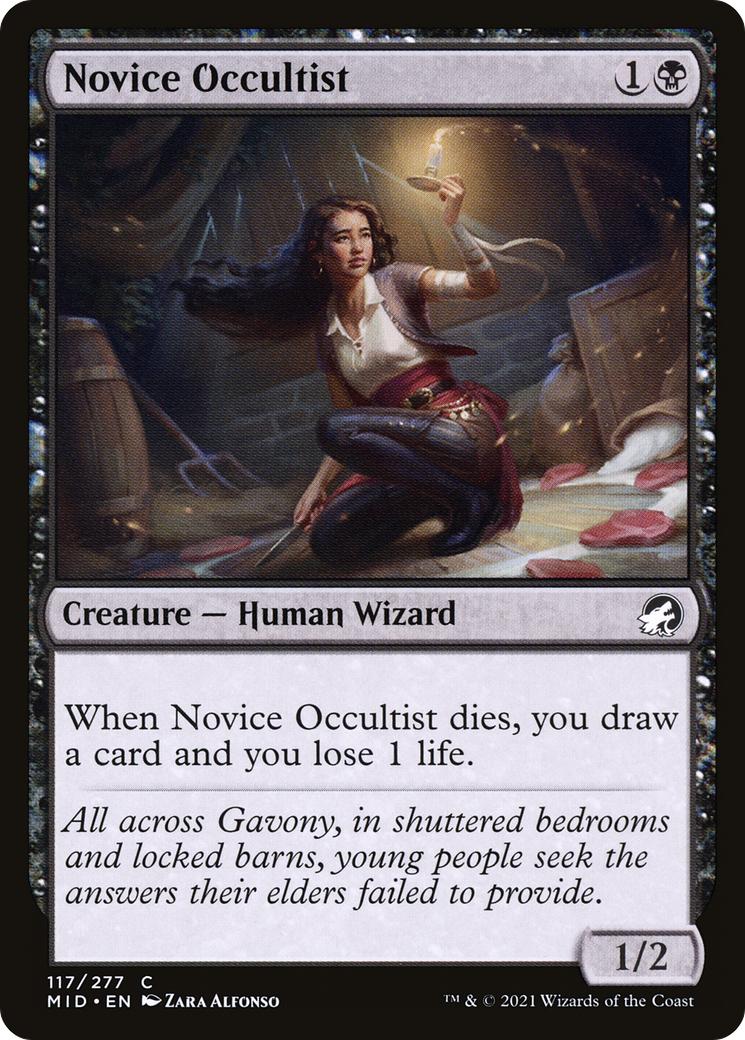
Novice Occultist is another black common creature, like Ecstatic Awakener, who makes for a good sacrificial lamb.
It has an ability that when it dies, you draw a card and lose one life. This turns the sacrifice from a downside into an upside. You draw two cards total – one from Novice Occultist, and one from Ecstatic Awakener.
The mana costs line up as well for a 1-2-3 punch. You have a potential line to play Ecstatic Awakener on turn one, drop Novice Occultist on turn two, then on turn three, you can activate Ecstatic Awakener’s ability, sacrificing Novice Occultist, draw two cards, and have a big demon to attack with. Not a bad start!
Another card in the same set has synergies with sacrificing. Jadar, Ghoulcaller of Nephalia is a rare black creature who ensures that you have a constant stream of zombies at your side, no matter how many you sacrifice.
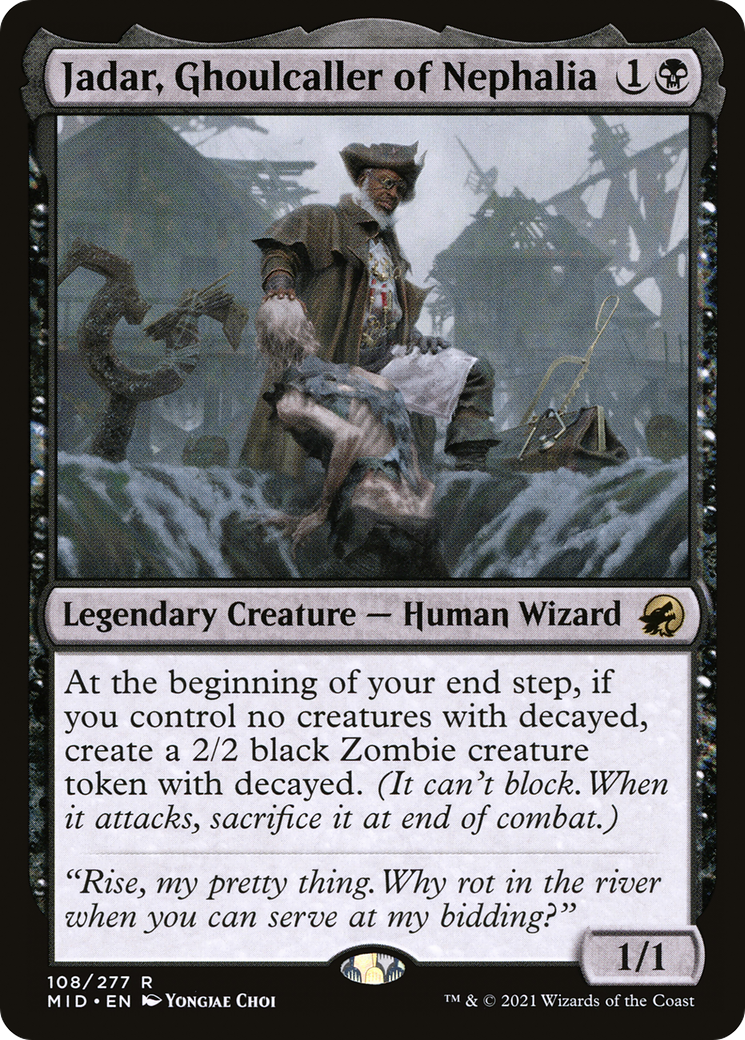
Its ability does a check as your end your turn. If you don’t have a zombie token, you create a new one. What happens if you sacrificed your zombie token earlier this turn to transform Ecstatic Awakener? You get a new one!
With Ecstatic Awakener’s ability, if you can sacrifice a creature that comes back, and then draw a card, you’ll be able to generate some card advantage over your opponent.
Card Advantage
There are many resources in a game like Magic, such as life total, lands, creatures in play, etc. One resource to keep track of is how many cards you have access to in a given game.
If you are able to draw more cards than your opponent, you have a greater chance of executing your game plan.
Normally, sacrificing would cost you a card. You had to draw your creature, and you paid mana to play it, too. Now you’re going to give that up for an ability?
Ecstatic Awakener works around the pain of being down a card by including a card draw in its ability. You can be card neutral by sacrificing a creature and drawing a new creature, or even gain some card advantage by sacrificing a card with synergy with sacrificing.
The card draw in this ability rewards deck building and foresight, and can help ameliorate the pain of sacrificing as well.
Ability at Instant Speed
Ecstatic Awakener’s ability has another quality that you won’t find mentioned on the card. The ability is an activated ability, and you can choose to use it at any time.
This means that you can choose to play it on either your turn or your opponent’s turn. A novice player might choose to activate this on their turn. A more skilled player would consider this, but they would also consider that they could choose to hold their resources up and wait to activate it until the end of their opponent’s turn. Waiting to activate this until the last minute would allow the player to see what their opponent has in store, and potentially take another course of action to respond, instead of committing to transforming their cultist.
Activating an ability at instant speed means you can activate it in response to what your opponent does. Let’s say you go in for an attack with your creatures, and your opponent plays Defenestrate targeting your Gisa. When that spell resolves, Gisa will be dead!
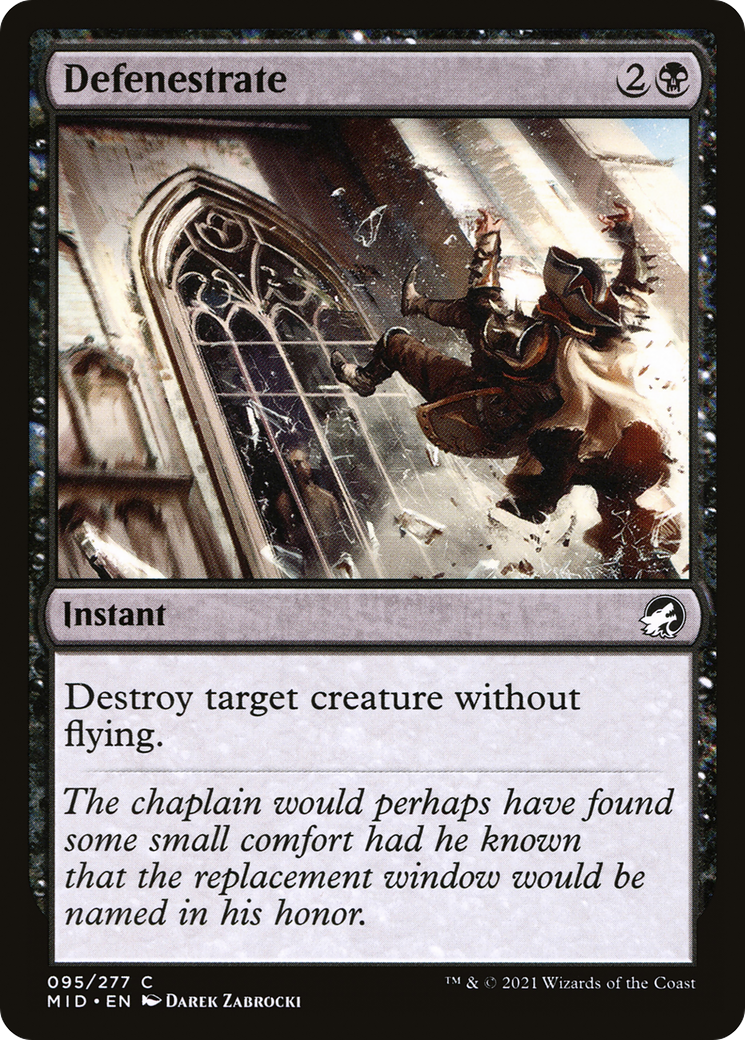
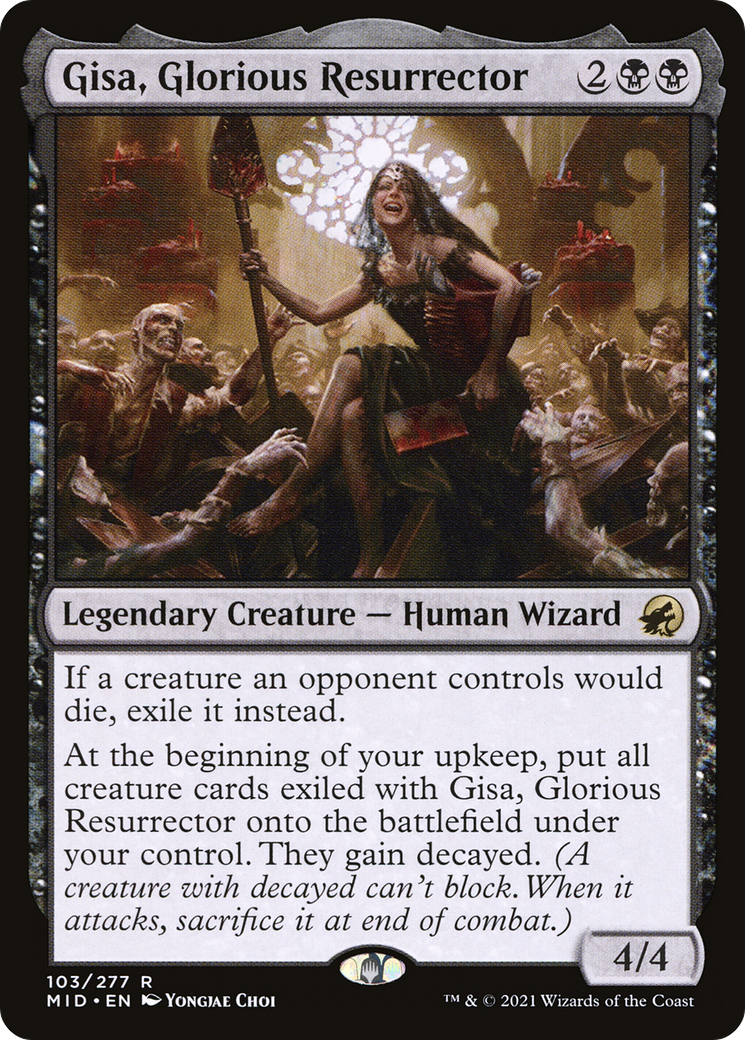
In response, you can choose to sacrifice Gisa to your Ecstatic Awakener’s ability. Will that save Gisa?
No, she is very much still dead.
However, you’re able to take a situation where your opponent is playing a card to remove your card, or essentially trading cards one for one, and instead sacrifice that card to draw another card. Instead of a one for one card trade, you turn it into a one for none card trade, since you have the same number of cards as before. And you’ve still turned your 1/1 human into a 4/4 demon.
Transformation
As mentioned before, Ecstatic Awakener // Awoken Demon is printed on one card, with one side showing the human and the other showing the demon. This does create some logistical issues since the card does not have a cardback to prevent showing what the card is in your deck or in your hand.
There are token cards in the set that allow you to write the names of your double faced card and that have a card back. In a pinch, you can take any card and write in sharpie that it is a placeholder for your double faced card. You can also play with card sleeves, which give your card a new card back via the sleeve.
There might be a hiccup or two when it comes to playing with a double faced card, but the payoff is worth it. After playing your cultist, playing an unsuspecting victim, then sacrificing said victim, you get to pick up your cultist and transform it into the demon they set out to become. Hell yeah dude.
This transformation mechanic allows us to play a mini-game within our game of Magic the Gathering. We have a setup when we play the card on the front side, and we get a payoff when we activate the ability and transform the card to its back side.
When we play card games like Magic, we’re playing to win, of course. After all, that’s the objective of the game. But winning alone is not the only fun part of playing Magic. Sometimes, you want to do the cool thing.
Magic is a zero sum game – someone has to win for someone else to lose – but having fun is not. You can have fun playing a deck that you like that may not be optimal and lose, or you can win playing an aggro deck that bores you to death.
Successfully activating Ecstatic Awakener’s ability is doing a cool thing. You get to live out a taboo power fantasy of sacrificing another to turn yourself into a demon. Even if you lose, you’re winning in the eyes of the demon lord Ormendahl.
Conclusion
Ecstatic Awakener // Awoken Demon stands out as an incredibly well designed card that has it all; flavor, payoff, identity, story. And it’s a common card! That’s the kicker of it all. A card that is this rich and fun is put in at the common rarity.
When we look to analyze other games, or even to make our own, we should stop and ask ourselves if the common pieces of the game, what some people might refer to as “filler,” are as fun and flavorful as Ecstatic Awakener. It can feel like we want to have bland filler pieces to contrast with the stand out legendary stars of our game, but just because a card is a common doesn’t mean it it can’t be fun in its own right.