Designing Dinosaur Cards
21 Mar 2026Dinosaurs are awesome! Let’s take a look at the design of some dinosaur cards, and see if we can’t come up with some new ones of our own.
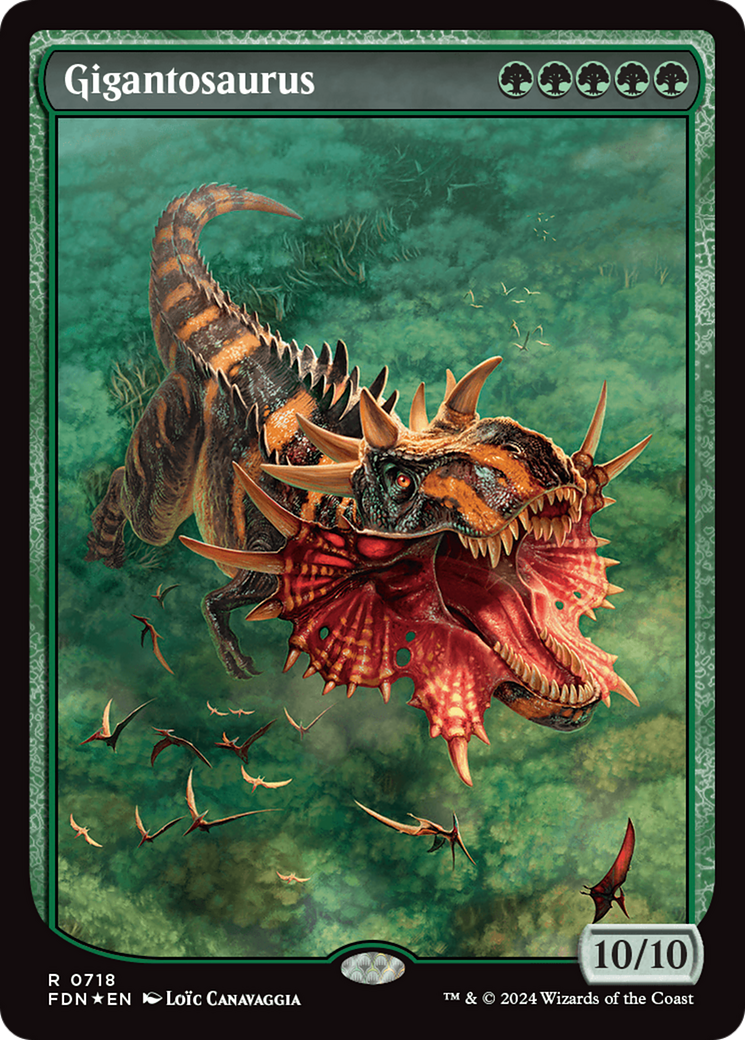
Dinosaurs have a unique quality among other elements in our fantasy media in that they were real. Of course, no one has ever seen a living dinosaur, but fossils show that these terrible tyrant lizards walked and stomped on the same ground that we walk today.
Scientists have studied dinosaur fossils and records for hundreds of years. We have real world knowledge of dinosaurs we can take inspiration from. Let’s try and define some qualities of dinosaurs in games, and see what designs we can come up with.
Primal Dinosaurs
Dinosaurs existed in a prehistoric time. They inhabited the same world that we live in today, separated from us by millions of years.
They represent primal nature at its height, unmarred by human action or artifice. They operated on instinct, looking only to eat, procreate, and not die.
In terms of gameplay, dinosaurs in games tend to fall on the lower end of complexity. You won’t find a dinosaur counterspell or a dinosaur artifact with multiple effects. Dinosaurs are known for many things, but subtlety is not one of them.
Big Dinosaurs
Dinosaurs are, famously, big. They are the largest animals to ever walk the earth.
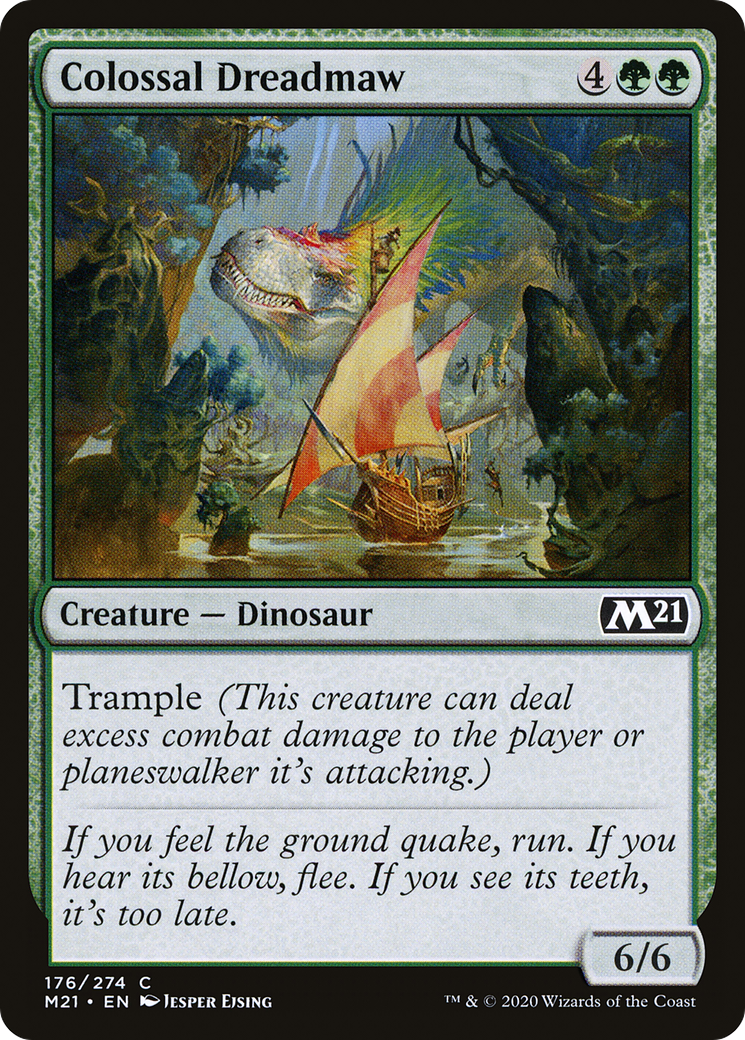
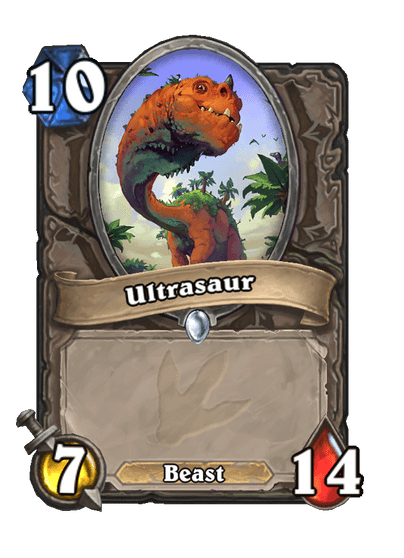
Dinosaurs as such are usually put onto big cards, both mechanically and by flavor.
Dinosaur Eggs
Dinosaurs laid eggs to procreate.
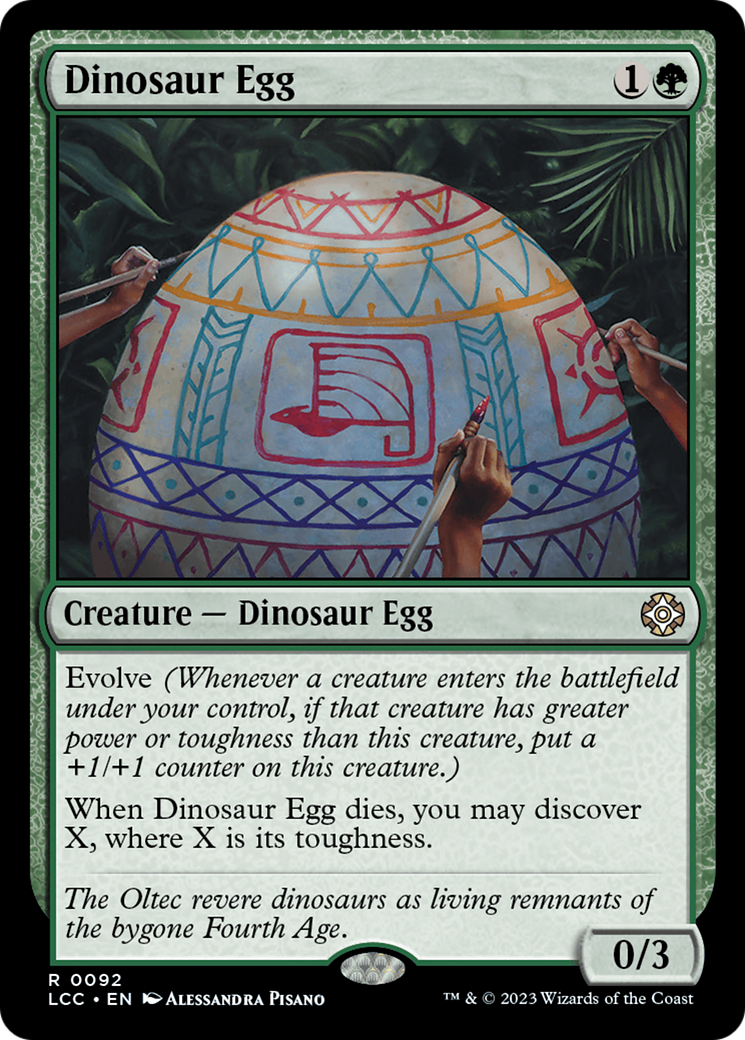
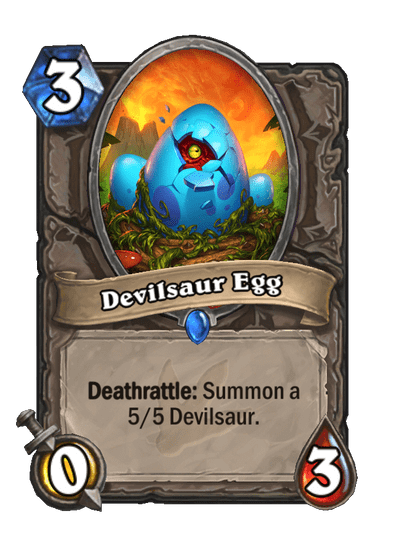
Eggs themselves have a few intrinsic properties. Eggs lie still and do nothing, but they carry the promise of future life. Eggs can also contain mystery – if you don’t know the parent, you may be surprised when the egg hatches.
Dinosaur Eggnappers
Dinosaurs are big, and so were their eggs. This created an opportunity for animals to take dinosaur eggs as a source of food.
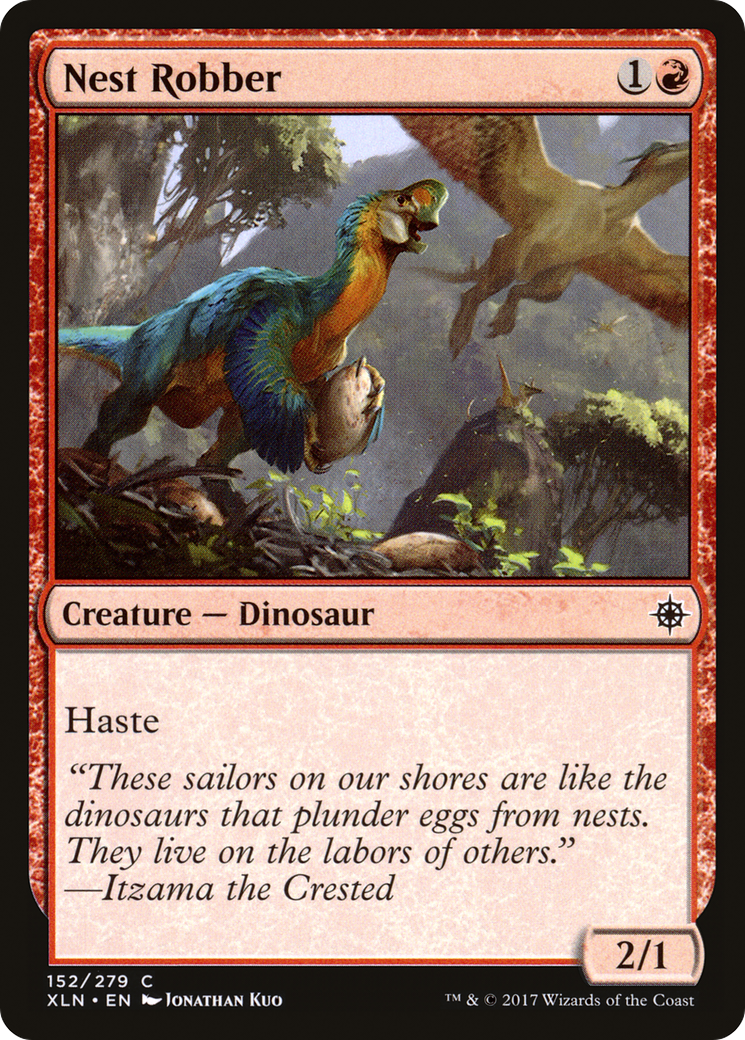
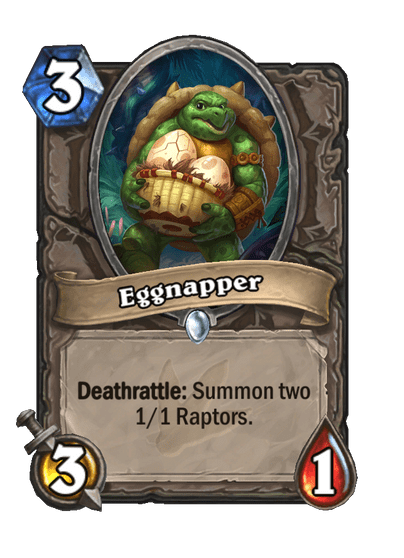
We see depictions of eggnappers in card games, but their mechanics are usually bare and only tangentially related to the act of robbing a nest. Nest Robber has haste, to imply that it is quick and nimble. Eggnapper appears to be quite unsuccessful in its egg napping, summoning raptors when it falls.
Many dinosaur species suffered from the issue of having their eggs robbed, and it seems that in reality, eggnappers were quite successful. Personally, I think there’s some design space to depict a successful eggnapper (we’ll get to that in a bit.)
Scavenger Dinosaurs
Dinosaurs had many strategies for finding sources of food. Some were herbivores, eating different types of plants. Some were carnivores, hunting down prey. Other carnivores were scavengers, meaning that they ate dead animals that they found.
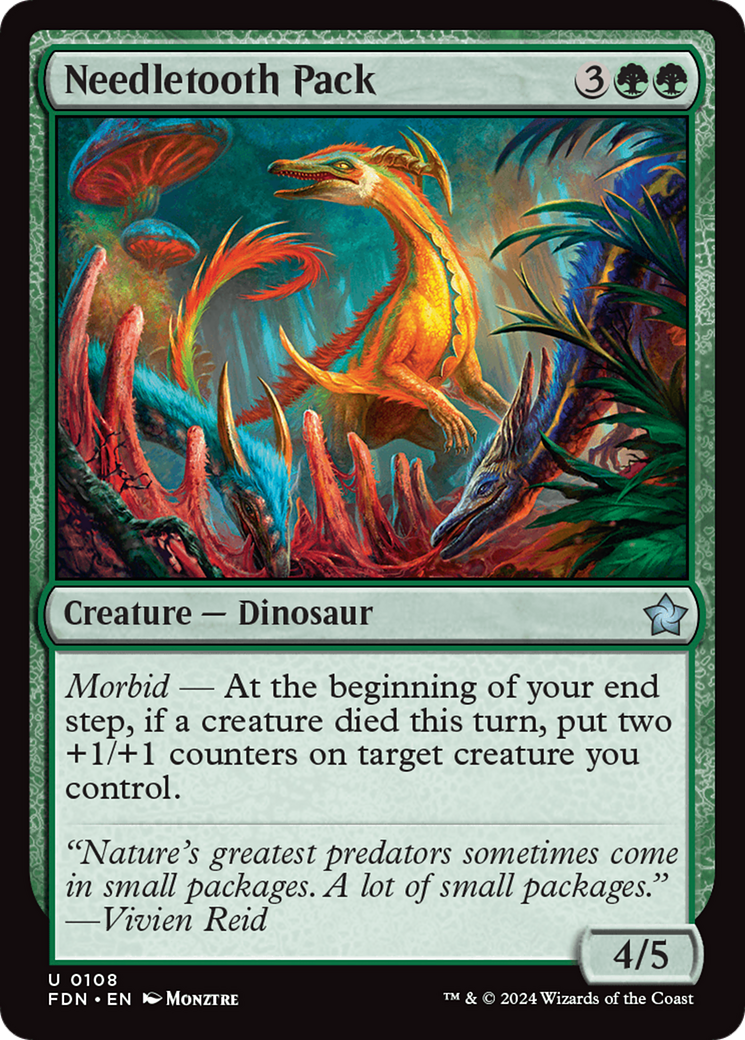
Contrary to popular belief, there were quite a few scavengers among our dinosaur friends. Tyrannosaurus Rex, king of dinosaurs, was an apex predator, but also scavenged and ate what it could when the opportunity arose.
Dinosaur Herds
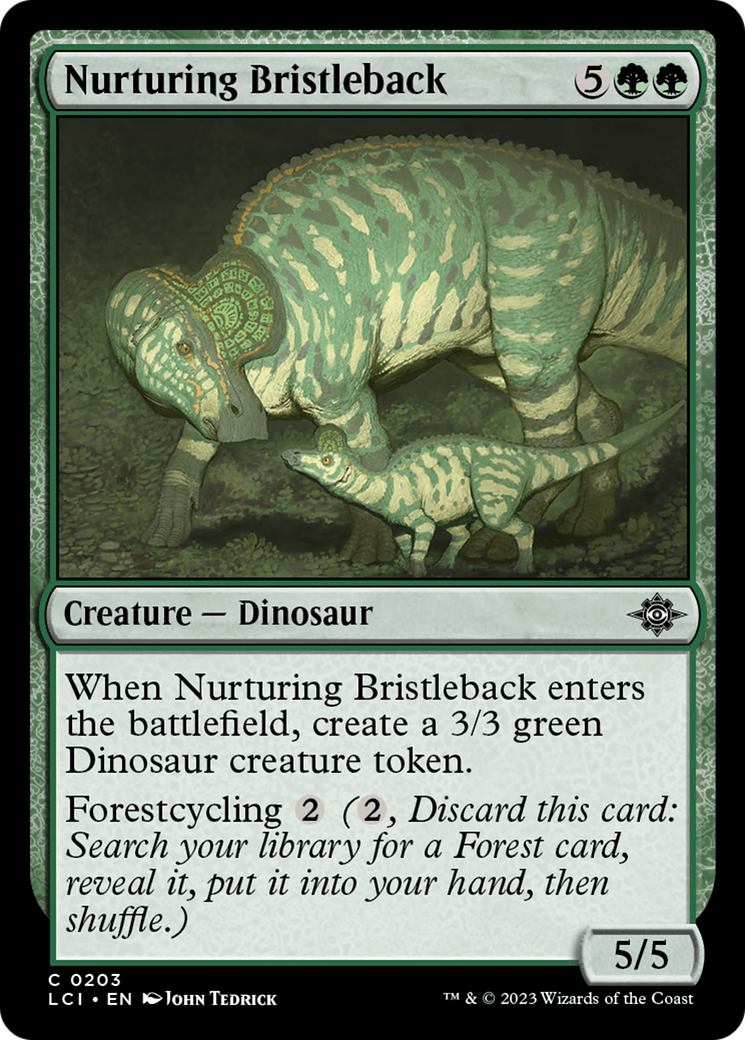
Some dinosaurs traveled in herds together. Herbivores would live together in groups for protection, and predators would hunt together in packs to bring down prey larger than they were.
Fighting Dinosaurs
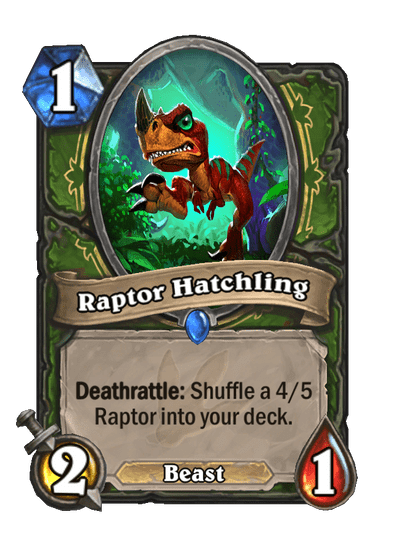
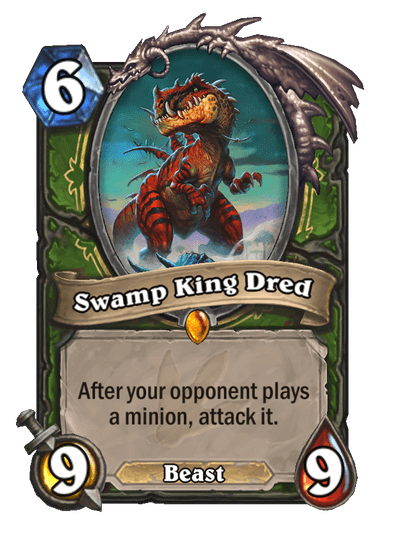
Dinosaurs had to fight to live. Either you were the hunter, and you were killing another dinosaur for your next meal, or you were the prey, and you were fighting to survive.
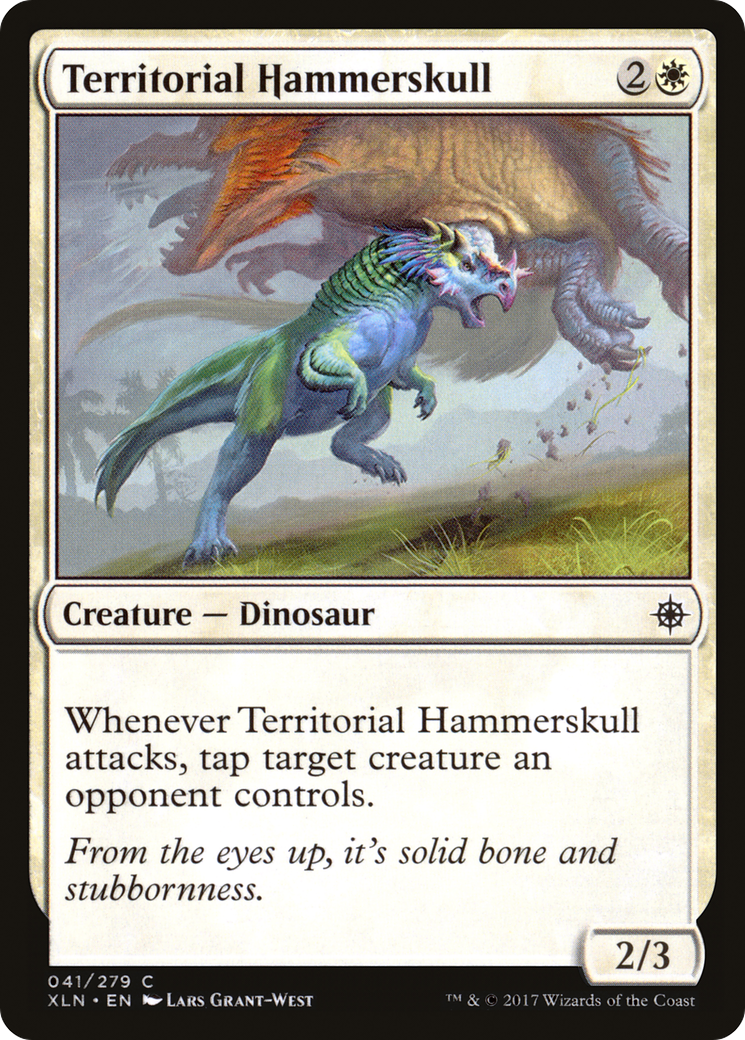
Different dinosaurs had different tools at their disposal. Pachycephalosaurus had a hard skull to headbutt with, Stegosaurus had a Thagomizer on its tail to swat away foes, and Tyrannosaurus Rex could chomp through anything.
Dinosaurs as Pandora’s Box
“Your scientists were so preoccupied with whether or not they could, they didn’t stop to think if they should.”
It’s hard to talk about dinosaurs, and especially people’s perception of dinosaurs, without talking about elephant, or Tyrannosaurus Rex, in the room, Jurassic Park.
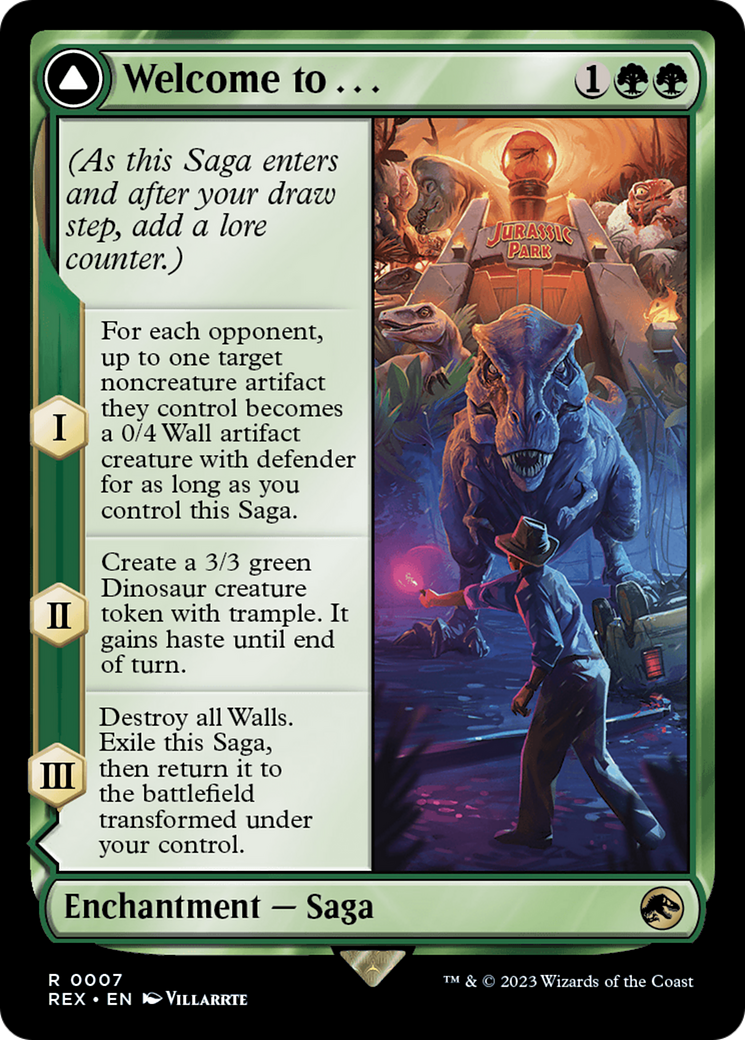
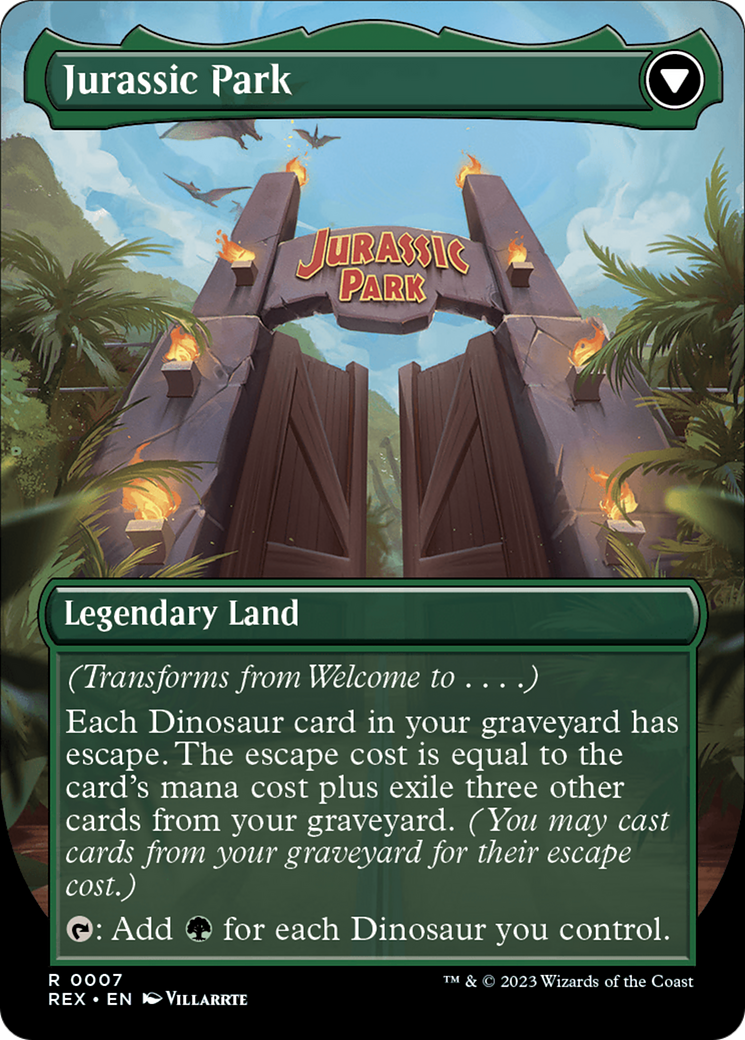
Ever since Jurassic Park, dinosaurs in media have been presented as a Pandora’s Box. We may have the ability to alter DNA and restore extinct species back to life, but should we?
This notion that our scientific advances in genetic mutations could have unintended consequences has permeated throughout dinosaurs’ media representation.
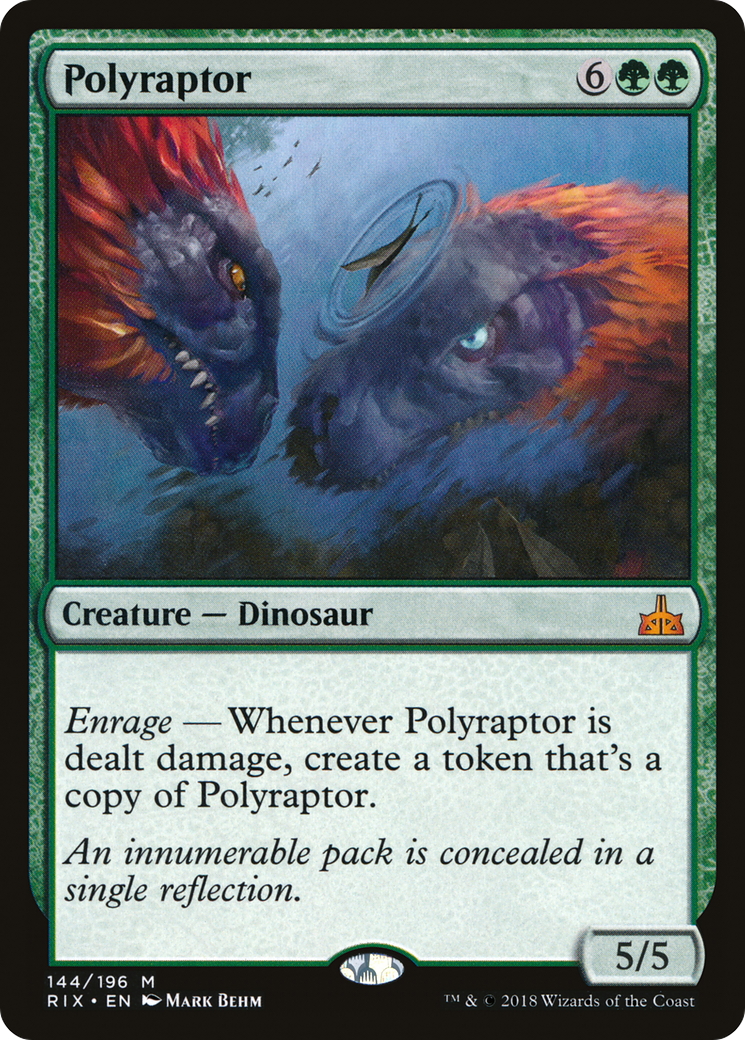
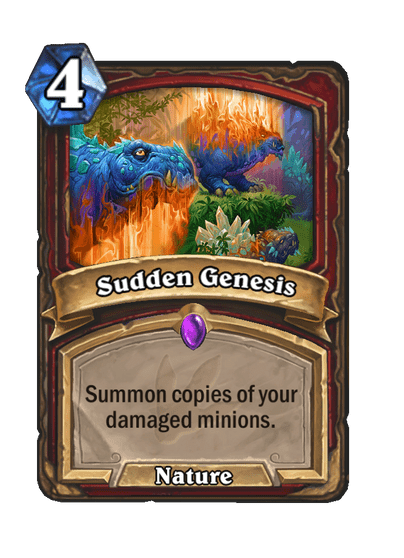
In card games, this fear of what could happen with genetic alterations and dinosaurs comes to be represented in the form of creating copies of creatures. The copying effect has a strong flavor of unleashing a terrible power.
Meteoric Extinction
No one knows for sure what led to the end of the dinosaurs, but the prevailing belief among scientists is that a meteor hit Earth, creating a devastating impact around it, and altering the atmosphere and the ecosystem of the planet such that dinosaurs could no longer thrive.
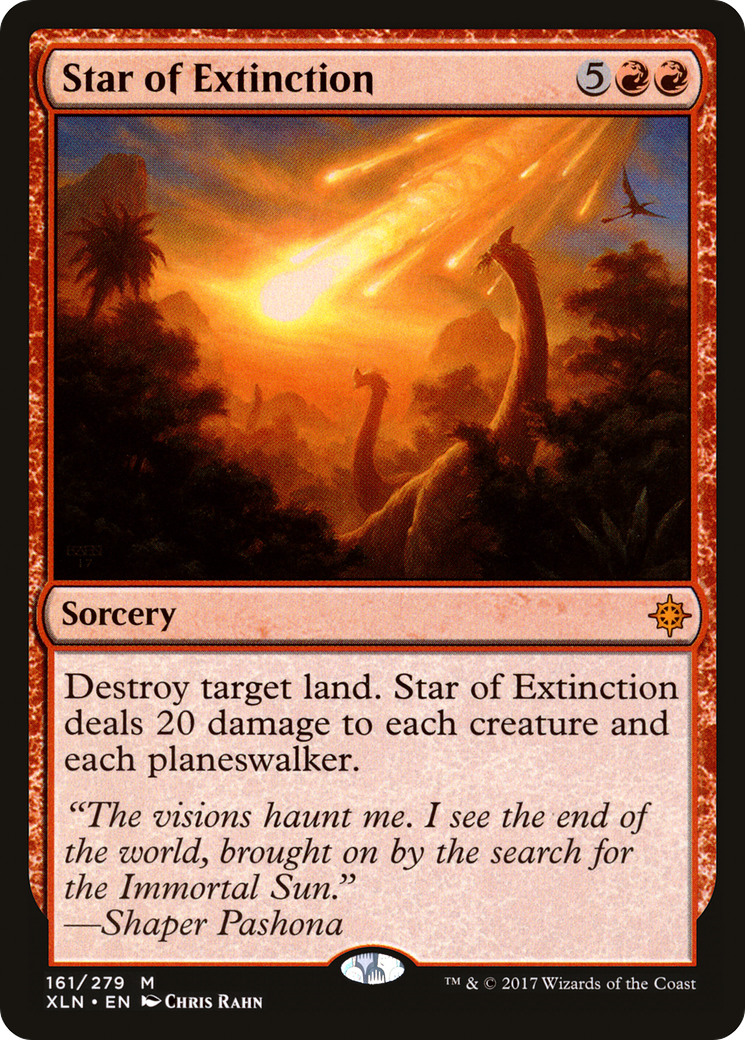
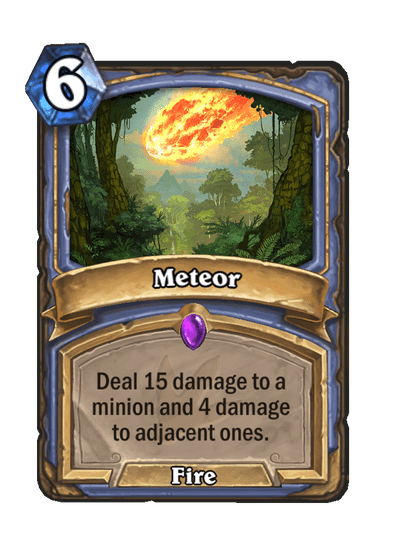
In card games, this meteoric event is represented through spells or actions that deal massive damage to multiple creatures, and potentially wiping the board.
Our Own Designs
After looking through hundreds of cards and seeing what dinosaurs existed, I wanted to make some of my own!
CARDNAME (Triceratops)
3{W}
Creature - Dinosaur
3/2
---
CARDNAME enters the battlefield with a shield counter on it.
CARDNAME has first stike as long as CARDNAME has a shield counter on it,
This card is a Triceratops that fights ferociously with its crest, but once that has broken, it’s much easier to defeat.
Mechanically, this would be a very tough creature to fight. The shield counter means it ignores the first instance of damage it gets, and first strke means that it deals damage before receiving it. I could see this card being quite strong. We could increase the mana cost by one, or alternatively remove the first strike ability and add two toughness, making it a 3/4.
CARDNAME (Pack Leader)
5{W}
Creature - Dinosaur
3/4
---
When this creature enters, create two 2/2 TOKEN NAME.
An army-in-a-can. You play it and get three bodies and 7/8 worth of stats. The art for the tokens can be smaller versions of the pack leader dinosaur, and you can have the art show the three dinosaurs together from different perspectives.
CARDNAME (Dinosaur Egg)
1{G}
Artifact
---
At the beginning of your upkeep, place a hatchling token on CARDNAME.
Remove three hatchling tokens from CARDNAME, sacrifice CARDNAME: Reveal cards from the top of your deck until you reveal a creature. You may place that card onto the battlefield.
Whenever one or more creatures an opponent controls attack you and aren’t blocked, destroy CARDNAME. Your opponent gains three life.
Here we have a dinosaur egg that takes some time to hatch. This can be played in a deck with many high mana value creatures to cheat out big monsters, or could also be played in a control deck to take advantage of a stalled board and get card advantage.
CARDNAME (Egg Stealer)
{B}{R}
Creature - Dinosaur
2/2
---
Haste
If this creature deals combat damage to a player, mill the top card of that player's library. If that card is a creature card, draw a card.
On the flip side, we have an egg stealing creature that lets you reap the rewards of stealing from your opponent’s nest. You can find an opening and sneak in this card to hit them and steal some card advantage.
CARDNAME (Parasaurolophus)
3{U}
Creature - Dinosaur
---
3/3
When this creature enters, tap and stun target creature.
This is one of the only dinosaurs that I would consider to be in blue, the color of knowledge and control. Parasaurolophus had a large horn on its head that was hollow and could have air blown through it. Paleontologists suspect that this horn could be used as an intimidation call.
On the card, we represent this horn call as a way of tapping down and stunning an opponent’s creatures, making them appear intimidated and backing down. The Parasaurolophus enters the battle with a mighty warcry, and an opponent’s creature becomes paralyzed with fear.
CARDNAME (Velociraptor Packmate)
2{R}
Creature - Dinosaur
2/2
---
This creature has flash if you control another dinosaur creature.
First Strike
Here we have a velociraptor that can use stealth and teamwork to defeat enemies. It ambushes enemies out of your hand to turn the tide of battle and hopefully eat up your opponent’s creatures.
It is enabled by having another dinosaur creature, rewarding you for playing more dinosaurs and tapping into the flavor of having a pack of dinosaurs working together.
CARDNAME (Scavenging Tyrannosaurus)
5{B}
Creature - Dinosaur
4/3
---
Menace
When this creature enters, you may exile up to three creature cards from a graveyard. Put a +1/+1 counter on it for each creature card exiled.
Here we have our ode to the scavenging Tyrannosaurus Rex.
I can see why T-Rexes don’t often have their scavenging nature depicted in media. Even as the king of dinosaurs, they only have so much screen time, and they have to play their role as the star. Their presence might be diminished if they are shown to be vultures looking for a free meal, instead of as an apex predator.
Regardless, here is our attempt to show T-Rex as both a fearsome monster and as a scavenger. You are rewarded for scavenging when it enters, and it can come in as a large threat with evasion.
CARDNAME (Baby T-Rex)
{G}
Creature - Dinosaur
1/1
---
Morbid - Whenever another creature dies, if that creature has greater power or toughness than this creature, put a +1/+1 counter on this creature.
This creature has trample as long as its power is 4 or greater.
The progeny of our scavenging Tyrannosaurus Rex. Here, we play with the Morbid and Evolve keywords in Magic. The Evolve keyword allows you to put a +1/+1 counter on a creature with said keyword if you play another creature that is larger. We twist that ability into one that triggers on death. The baby T-Rex eats when something else dies, and continues to grow.
CARDNAME (Gore)
3{G}
Sorcery
---
Target creature deals damage equal to its power to another target creature. Deal excess damage to another target creature.
This card is a powerful piece of removal in green that rewards playing creatures with high power. You can use it to remove another creature from the board, and if you play your cards right, you could potentially get two creatures for one card.
CARDNAME (Tyrannosaurus Rex)
4{G}{G}{G}
Creature - Dinosaur
10/10
---
Trample, Haste
This creature must attack if able.
A big dinosaur card for a big dinosaur. We want to bring the game to an end, and this card will have an effect the turn it hits the board. I tried to capture that it’s hungry and instinct driven by removing the decision of having it attack or not.
I almost didn’t add the trample ability as I wanted to have it be able to be blocked. Every turn, this giant creature would swing in, and your opponent would be forced to sacrifice a creature to it, or otherwise lose the game. However, I checked, and the many T-Rexes in Magic all have trample. I don’t want to break convention here so trample it is. Plus, closing out the game with a big creature is probably more fun than dwindling down resources and having one player lose all hope.
Conclusion
I hoped you liked some of the cards designed above. They take the inspiration from the base elements of dinosaurs and put them into new magic cards.
I do want to mention that the elements above, such as a primal nature, bigness, or scavenging, are elements that are inherent to dinosaurs in and of themselves. Great and original games will take these elements and put their own spin on them. What if the dinosaurs were domesticated by humans, and people rode dinosaurs into battle? What if dinosaurs continued and evolved their own intelligent species to match humanity?
Much like how Game of Thrones pulls heavy inspiration from the real history of the War of the Roses, so too can we pull heavy inspiration from real things like dinosaurs and cast them through our own lens to invent something new and give our players an experience they’ve never had before.